Aug 011984
 

Contents:
Openers: Money, Effort, Dedication; From the President; Talkin’ Philosophy; Freedom Party only Political Party Supporting Freedom of Speech; Our Continuing Battle Against Censorship; “Freedom Party praises AMI’s handling of hospital” (newspaper coverage); Planning and Preparation for Municipal Elections (Part 3); What Price Freedom? What Cost the Lack of It? Continue reading »

Aug 011984
 

1984-02-27.emery-thumbAUDIO – DESCRIPTION:

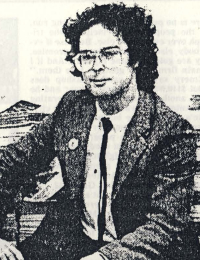
In 1984, the leftist London Union of Unemployed Workers (LUUW), led by activist John Clarke, performed a sit-in at the office of London Mayor Al Gleeson, to bring attention to the financial situation of two London mothers. In this recording, radio host Wayne Maclean had Clarke and London alderman Joe Fontana on the show as guests to discuss the LUUWs activities. Marc Emery, then Freedom Party of Ontario’s Action Director, calls into the show in response to Maclean’s comment that the ease with which one can get welfare makes us an “enlightened society”. Emery asserts that most of ones problems are the result of the decisions one has made. He takes particular issue with Maclean’s comment that the threat of government enforcement of tax laws is “just a perception”.

You can listen to the entire 1 hour and 35 minute broadcast. Emery calls in at approximately the 1 hour, 26 seconds mark:

or listen just to an excerpt from it, being Emery’s call into the show:

Continue reading »

Jul 301984
 

1984-07-30.main-points-thumbDescription:
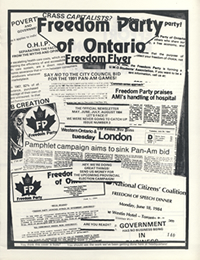
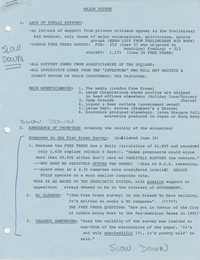
In the summer of 1984, Freedom Party Action Director Marc Emery wrote a letter to the editor of the London Free Press opposing taxpayer funding for London, Ontario’s City council’s bid for the 1991 Pan Am Games. It was so heavily edited by the paper, that Emery decided to print 20,000 copies of a letter. With Freedom Party co-ordinating 15 volunteers, the letter was delivered door-to-door to Londoners. It would mark the beginning of a Freedom Party campaign that, in June of 1985, met with success.

Freedom Party kept track of responses to the letter and put together a list of main talking points for use during interviews or call-ins to talk radio programs about the subject.
Continue reading »

Jul 241984
 

AUDIO – DESCRIPTION:

In July of 1984, then Freedom Party of Ontario Action Director Marc Emery, together with volunteers from the Freedom Party of Ontario, went door-to-door distributing a letter opposed to taxpayer funding for the Pan Am Games. A local contingent of businessmen and municipal politicians had tendered a bid for London, Ontario to host the 1991 games, and the bid included a budget in which taxpayers would be stuck with picking up the lions’ share of the tab. Emery had submitted his letter to the local London Free Press, which had declined to print it. After Emery’s letter was distributed door-to-door, a No Tax for Pan Am Games Committee was formed, which published a number of newsletters to keep opponents of taxpayer funding for the games aware of developments. Ultimately, in early 1985, Emery and Freedom Party were successful: thanks largely to their organized opposition to taxpayer funding for the games, public outcry against public funding for the games ultimately resulted in Canada’s then federal Minister of State for Fitness and Amateur Sport, Otto Jelinek, issuing the announcement of a 5 year freeze on taxpayer funding for sporting events. The London bid was dead. The 1991 Pan Am Games were held in Cuba, at the expense of Cuban taxpayers.

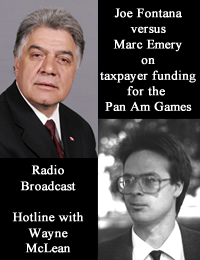
In this Radio 98 episode of Wayne McLean’s show “Hotline”, Marc Emery and then London alderman Joe Fontana debated taxpayer funding for the London Pan Am Games bid.

Note: This audio is captured from a cassette tape. The recording on side 2 of the tape suffers from speeding-up and slowing down of the tape that appears to have been caused by variable slowing of the tape reel during the recording of the broadcast (the tape, itself, is not stretched or creased or otherwise damaged and the cassette mechanism moves freely). This digital capture plays side 2 continuously after side 1, such that the audio irregularities are heard during the second half of the recording.

Continue reading »